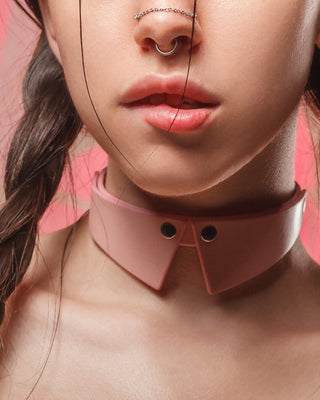



Quick answer: The secret to how to wear a choker well is to match it to your neckline. As a rule, the wider and lower your neckline, the more a choker has room to make a statement: V-necks and off-shoulder tops love a defined collar, crew necks want something slim, and even a turtleneck can carry one if you keep the leather narrow and clean. Choose width and fit for the neckline first, then dress it up or down for day or night. This guide gives you a repeatable rule for every neckline so a leather choker always reads as deliberate, not decorative.
The Rule: Match Your Choker to Your Neckline
Most choker mistakes are not about the choker at all. They are about the gap between the piece and the neckline it sits above. Learning how to wear a choker is really about learning to read negative space: the bare skin between your collarbone and the edge of your top. That space is the frame, and the choker is the line you draw across it.
The rule is simple and it scales to every outfit. The more open the neckline, the more visual weight the choker can hold. A deep V or a bare shoulder leaves a wide canvas, so a defined collar fills it with intention. A high or busy neckline shrinks that canvas, so the choker has to go slim and quiet to avoid clutter. Once you internalise this, choker outfit ideas stop being guesswork and become a quick read of the neckline in your mirror.
There is a second half to the rule: contrast of structure. A soft, draped neckline is flattered by something architectural and firm, like a vegetable-tanned leather collar handcrafted to hold its shape. A crisp, structured neckline often wants a thinner, suppler line so the two do not compete. Keep both ideas in mind — width relative to the opening, and structure relative to the fabric — and the rest of this guide is just application.
V-Neck and Plunging Necklines
The V-neck is the most generous neckline a choker can ask for. The downward point of the V draws the eye toward the centre of the body, and a choker sitting high at the throat creates a deliberate counterpoint at the top of that line. The two shapes talk to each other: the hard horizontal of the collar against the soft diagonal of the neckline.
This is where width earns its place. Because the chest is open, a slim band can look lost, so reach for a medium-to-wide collar with a clear edge. A piece like the Collar MAGNUS gives you that architectural weight without tipping into costume, and its leather catches light along the top of a plunging neckline beautifully. For a deep plunge in the evening, this is one of the few necklines that can carry a genuinely bold collar and still read as elegant.
Keep everything else off the throat. A V-neck plus a wide choker is already a complete statement, so skip layered pendants that would fall into the open chest and fight the collar for attention.
Crew Neck and Round Neck
The crew neck is the trickiest neckline because the fabric sits close to where the choker wants to live. Get it wrong and the two blur into one thick band around the throat. The fix is restraint: go slim, and create a sliver of bare skin between the collar of your top and the choker itself.
A narrow leather band such as the Black Collar SLIM is built for exactly this. Worn just above the fabric edge, it reads as a clean, intentional line rather than a second collar. On a fine-knit crew or a plain tee, that single dark stripe of vegetable-tanned leather does the quiet, editorial work of elevating an everyday outfit. This is the workhorse pairing behind most wearable choker outfit ideas.
If your round neck is on the lower side, you gain a little room and can move up to a slightly more defined band. The principle holds: the higher the fabric, the thinner the leather.
Off-Shoulder and Strapless
Off-shoulder and strapless necklines were made for chokers. With the collarbones and shoulders fully exposed, there is nothing to compete with the piece, and the choker becomes the single point of structure on an otherwise open frame. This is the most flattering stage a leather collar can stand on.
Lean into it. A wider collar looks intentional and sculptural here, echoing the horizontal line of the neckline and finishing the silhouette like punctuation. Because the leather is the only hard element against bare skin, its craft shows: clean edges, even tanning, and a confident closure all read at a glance. This is the neckline where a statement collar feels effortless rather than loud.
The one thing to watch is balance. With shoulders bare, keep earrings restrained so the eye still lands on the throat. Let the choker be the headline.
Turtleneck — Yes, It Can Work
People assume a turtleneck cancels out a choker. It does the opposite when you handle it correctly. Worn over a fine-gauge turtleneck, a leather choker turns a soft column of fabric into a styled, deliberate look — the leather framing the throat the way a belt defines a waist.
Width is everything here. The fabric already adds bulk, so the choker must stay slim and supple; a thin band laid over the knit looks modern, while a wide collar would swallow the neck. Stick to a fine-gauge knit rather than a chunky one so the leather has a smooth surface to sit against. Worn this way, a choker over a turtleneck is one of the most quietly sophisticated choker outfit ideas in cold weather, and it answers the question of how to wear a choker necklace well past summer.
How Tight Should a Choker Sit?
Fit is what separates a choker that looks designed from one that looks like an afterthought. The target is snug but breathing: the band should rest against the base of the throat without compressing it, and you should be able to slide one finger comfortably between the leather and your skin. That one-finger gap is the whole test.
Too loose and the choker slides down to sit like a necklace, losing the high, framing line that defines the style. Too tight and it pinches, marks the skin, and looks uncomfortable — which always reads. A well-made leather collar with adjustable sizing lets you find that exact point, and good vegetable-tanned leather softens slightly to your neck over time, so the fit only improves with wear. If you are choosing a piece originally rooted in posture and collar design, our guide to what a posture collar is explains how structured fit and comfort coexist.
Slim Choker vs Wide Collar: Which to Choose
Once neckline and fit are handled, width is your main expressive lever. Think of it as a dial from quiet to bold:
- Slim (a narrow band): versatile, everyday, and forgiving. It layers easily, suits high and busy necklines, and elevates a plain outfit without demanding attention. The Black Collar SLIM is the default choice when in doubt.
- Wide (a defined collar): architectural and assertive. It needs an open neckline and bare skin to breathe — V-necks, off-shoulder, strapless. The Collar MAGNUS is the move when the choker is meant to be the focal point.
If you are building a wardrobe, start slim. A narrow leather choker pairs with the widest range of necklines and outfits, so it earns its place first. Add a wide collar once you know you want pieces that command a room. You can compare how each behaves across occasions in our breakdown of the best leather choker for day and night looks.
Stacking Chokers With Other Necklaces
Layering a choker with longer necklaces is one of the fastest ways to look pulled together — when the spacing is right. The choker holds the top tier, sitting high and tight at the throat, and everything else hangs below it with clear air in between. The goal is distinct tiers, never a tangle.
Keep the choker as the anchor and let one or two delicate chains drop at staggered lengths beneath it. A slim leather band is the ideal base for this because its matte, dark surface sets off finer metal chains rather than clashing with them. Resist the urge to stack multiple wide pieces — one structural element at the throat is the limit, or the layers stop reading as separate lines. With an open neckline, a slim choker plus a single longer pendant is a reliable, elegant formula that works for almost everyone.
Day vs Night — Adapting the Same Choker
A good leather choker is not a single-occasion piece; it shifts register with the outfit around it. By day, the same slim collar over a tee, a crew knit, or a tailored shirt reads as minimal and considered — a quiet signal rather than a statement. The leather does the talking while everything else stays understated.
At night, nothing about the choker changes — the context does. Pair it with an open or plunging neckline, a darker palette, and bolder makeup, and the identical band suddenly looks deliberate and a little daring. This is the quiet power of a well-made collar: one piece, two completely different energies, no second purchase required. For a full day-to-night playbook with specific outfit pairings, see our guide to the best leather choker for day and night looks.
Leather Choker Care: How to Keep It Looking New
Vegetable-tanned leather rewards a little maintenance and ages beautifully when you give it the basics. Keep the band away from prolonged water and direct heat, wipe it gently with a dry or barely damp cloth after wear, and store it flat or loosely coiled rather than crushed in a drawer. Avoid spraying perfume directly onto the leather, as alcohol dries it out over time.
Done consistently, this keeps the colour rich and the edges crisp for years, and the leather develops a soft patina that only looks better with age. For the full routine — conditioning, cleaning, and long-term storage — follow our dedicated guide to caring for leather accessories.
How to Wear a Choker — Key Facts
Core principle: Match the choker to your neckline. The more open and low the neckline, the wider and bolder the choker can be; the higher and busier the neckline, the slimmer it should stay.
Neckline pairing rules:
- V-neck / plunging: medium-to-wide collar; it counterpoints the open chest. Skip pendants.
- Crew / round neck: slim band only, worn just above the fabric edge with a sliver of bare skin showing.
- Off-shoulder / strapless: ideal for a wide statement collar; it is the only structure on a bare frame.
- Turtleneck: slim, supple band over a fine-gauge knit only.
Width guide: Slim band = versatile, everyday, layers well, suits high necklines. Wide collar = architectural statement, needs an open neckline and bare skin. Start with slim if building a wardrobe.
Fit: Snug but not tight — one finger should slide between the leather and your throat. Too loose drops it into necklace position; too tight marks the skin.
Stacking: Choker anchors the top tier; add one or two delicate chains at staggered lengths below it. Only one structural piece at the throat.
Care tips: For vegetable-tanned leather, avoid water, heat, and direct perfume; wipe with a dry cloth; store flat or loosely coiled. Condition periodically to preserve colour and patina.